Tuesday, March 5, 2013

Student Research Spotlight- Polynesian Compliment Acceptance

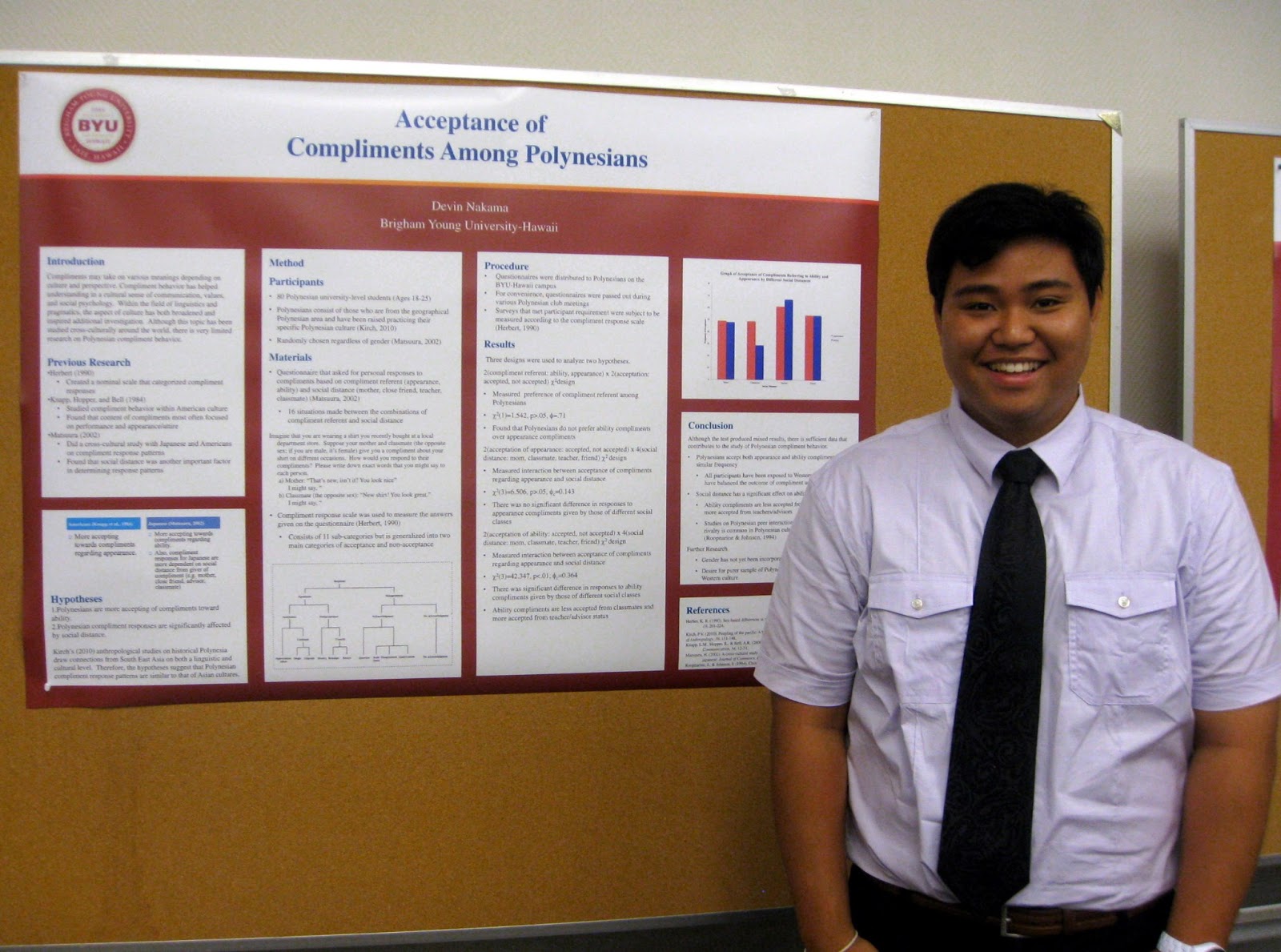
Acceptance of Compliments Among Polynesians
 
 
Devin Nakama


For his senior project, Devin analyzed participants' responses to different compliment receiving scenarios. His study focused on whether or not Polynesians preferred to accept compliments of ability or of appearance. Additionally the study analyzed the effect of social distance, like whether the compliment came from a peer, parent, or professor, on the acceptance of different types of compliments. The study found that Polynesians accepted appearance and ability compliments similarly. However, the results also showed that social distance mattered in acceptance of compliments on a person's ability.

Devin explains that he enjoyed his experience in the psychology department at BYUH. He had many of the same classmates in his Statistics, Research Methods, and Senior Seminar classes and he was able to see the growth in his peers as well as himself throughout this series of courses. He was surprised that it was not as difficult to conduct his research in PSYC 490 as he thought it would be, a fact which he attributes to the excellent preparation in PSYC 305. Devin shared that he really enjoyed seeing the presentations of his classmates' research projects, as it was like a showcase of everything they had learned over the years with a mix of their own creativity and interests.

He appreciates how the Psychology department really invests its time and efforts in the students, and how much passion the faculty has for the material they teach.

See Devin's full poster here.


Tuesday, February 12, 2013

Student Research Spotlight- Scents of Attraction

 
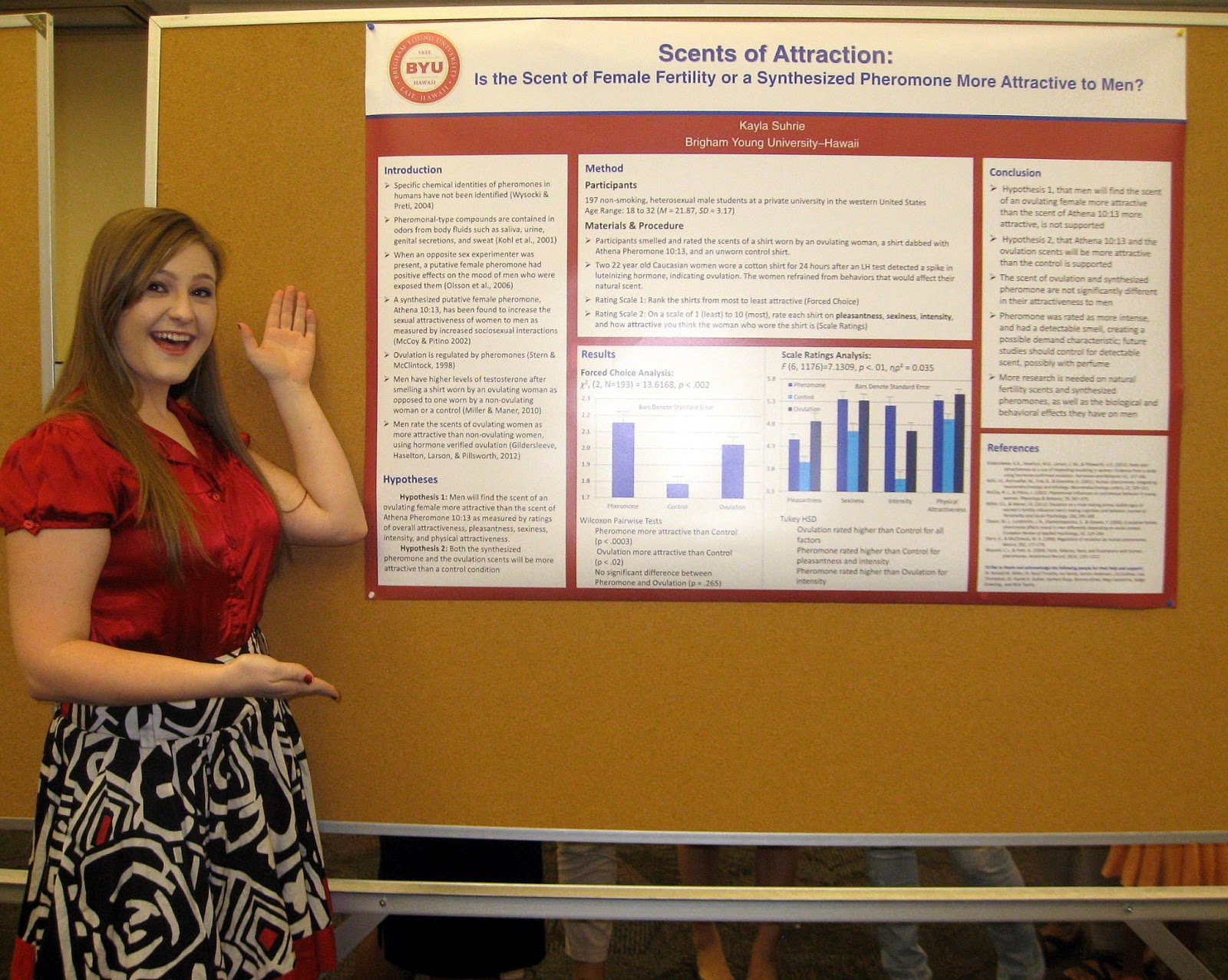
Scents of Attraction: Differences Between Synthetic and Naturally Occurring Fertility Pheromones


Kayla R. Suhrie

The psychology curriculum at Brigham Young University-Hawaii ends in a capstone course which allows students to conduct original psychological research, and subsequently present it on campus in two forms: a poster and powerpoint presentation.

One research project was recently completed by Kayla Suhrie, a senior this year. She conducted her research on how human pheromones drive behavior. This project, Scents of Attraction: Differences Between Synthetic and Naturally Occurring Fertility Pheromones, examined whether men would find the scent of a synthesized female pheromone to be more attractive than the scent of an ovulating woman, which has been found in previous research to smell attractive to men and increase testosterone levels. The research was designed in PSYC 305, Research Methods, and conducted in PSYC 490, Senior Seminar, both taught by Dr. Miller.
Kayla had male participants come in and smell shirts that had been unworn, dabbed with a synthesized putative pheromone, and worn by an ovulating woman and rate how attractive they found these scents. She recruited participants by offering them cupcakes. Many of those she recruited thought it was weird to smell shirts that women had worn, but others did so with enthusiasm. Some participants felt uncomfortable with rating the attractiveness of women based on the smell of the shirts, with one participant writing in that in spite of their low attractiveness scores, "I'm sure they would all make good mothers".

The results indicated that, overall, both the pheromone and ovulation shirts were more attractive than the control. In factors of attractiveness, the ovulation shirt was rated as smelling sexier, more pleasant, and more intense and estimating the woman who wore the shirt to be more attractive than the control, while the pheromone shirt was only more pleasant and intense than the control. Additionally, the pheromone was rated as smelling more intense than the ovulation scent. Kayla explains that the synthesized pheromone, which was labeled as unscented, had a bit of a sweet scent to it, which could have influenced ratings. She said more research would need to be done on the synthesized pheromone to determine if it is really as attractive to men as an ovulating woman, though it is clear that does smell attractive to men.

According to Kayla, the take away message is that men like the smell of women, whether real or just perceived. Even the control shirt, which was plain cotton, was rated as smelling rather attractive, which shows that men either like the IDEA of a woman's scent, or find the scent of cotton to be attractive.
Kayla explained that she was originally interested in researching something to do with dating or attraction between men and women. She came upon research studying a synthesized pheromone and thought and it would be interesting to look at that with LDS populations. However, upon learning about research on the effect of the scent of an ovulating woman on men, she decided it would be most interesting to compare the two pheromones.
Of the senior seminar research experience, Kayla noted that it was very empowering for her, as a student, to conduct her own research project. She said that while she received a lot of help from faculty and friends, it was a great learning experience for her to realize she could effectively do research similar to those that she read about in professional journals.
In addition to presenting her research to faculty and students in a poster session and presentation held on campus, Kayla also had the opportunity to present this research at a regional research conference, the 6th Hawaii Pacific University Psychology Conference & Awards Dinner Banquet.

This project has been accepted for presentation at the Association for Psychological Science National Convention in May 2013 to be held in Washington, D.C.

See the full poster here.

Saturday, December 15, 2012

December 2012 Graduates

Congratulations and Ho'omaika'i 'ana to our December 2012 Psychology Graduates!

Pictured below: Zackary Carling, Katherine Jensen, Alexa Tuita, Kylie Miles, Leslie Shepherd, Amberlyn Ieremia, Sela Unga, Elizabeth Wood. Not pictured: Andrew Alvarado, Zackery Kampf


Graduating psychology seniors with psychology faculty at the Psychology Senior Luncheon last week,


Tuesday, November 27, 2012

The 6th Hawaii Pacific University Psychology Conference & Awards Dinner Banquet


BYUH psychology students and faculty recently attended the 6th Hawaii Pacific University Psychology Conference & Awards Dinner Banquet, a regional research conference hosted every semester by Hawaii Pacific University’s Psychology Department, Psychology Club, and Psi Chi chapter. Students from HPU, Chaminade University, and BYUH presented research on topics ranging from university smoking cessation programs to jealousy and compersion in relationships. The dinner and conference brought students and faculty from these three universities together in a good-humored and encouraging atmosphere. Two BYUH psychology students presented research; Kayla Suhrie shared her PSYC 490 Senior Seminar project, while Lisa Thompson spoke about a project that the Neuroscience research group has conducted. Also in attendance were Drs. Ed Kinghorn and Boyd Timothy and psychology students Bonnie Allred and Meg Costantino.

Lisa Thompson presented “Using Likelihood Ratios to Detect Malingering in Practical Validity Measures”

Measures of malingering, or purposefully faking physical symptoms in order to gain external rewards, was examined in this study. The results supported having multiple assessments to detect malingering. Results showed that by using likelihood ratios, a mathematical formula that compares the probability that someone is malingering, results on three assessments can detect malingering with 90-99% accuracy. This is in contrast to the vote-counting enterprise method, which assumes malingering only if the majority of assessments revealed malingering.

Kayla Suhrie presented “Scents of Attraction: Differences Between Synthetic and Naturally Occurring Female Fertility Pheromones”

In this study, men smelled the shirts that had been unworn, dabbed with a synthesized putative female pheromone, and worn by an ovulating woman for 24 hours to compare how attractive they found these scents. Overall, both the pheromone and ovulation shirts were found to be more attractive than the control shirt. In factors of attractiveness, the pheromone and ovulation shirts were rated as smelling more pleasant and intense than the control while the ovulation shirt was rated as smelling sexier than the control and that the woman who wore the shirt would be more attractive than the woman who wore the control. The only significant difference found between the pheromone and ovulation scents was that the pheromone was rated as smelling more intense than the ovulation scent.


The following projects were presented at the conference:
Malia Preza (HPU), "Hawaii's Place and Race: How Space and Place Can Affect One's Cultural Values." [Faculty advisor: Katherine Aumer]

Acachia Schriml (HPU), "The Impact of Culture and Cultural Awareness on the Work Environment." [Faculty advisor: Katherine Aumer]

Brendan Ito (HPU), “Identity As Social Currency.” [Faculty advisor: Katherine Aumer]

Lisa Thompson (BYUH), "Improving the Detection of Malingering in Practical Validity Measures Using Likelihood Ratios." [Faculty advisor: BYUH]

Jeffrey Dennison and Alexander Purring (HPU), "Predictive Ability of Romantic Partners in Assessing Self-Esteem." [Faculty advisor: Patricia Ellerson]

Justin Garcia (HPU), "How Right and Might Can Lead to Fight: The Effect of Moral Absolutism and Honor on Criminal Behavior." [Faculty advisor: Katherine Aumer]

Stephen Steward and Patrick Dunne (Chaminade), “Ethnicity and Stages of Change for Campus Based Smoking Cessation." [Faculty advisor: Tracy Trevorrow]

Angelyn Uson and Amber Wong (HPU), "The Impact of Weight Disparity on Perceived Relationship Satisfaction." [Faculty advisor: Katherine Aumer]

Billy Bellew (HPU), "Jealousy and Compersion and Their Effects on Relationship Satisfaction." [Faculty advisor: Katherine Aumer]

Kayla Suhrie (BYUH), "Scents of Attraction: Differences Between Synthetic and Naturally Occurring Fertility Pheromones." [Faculty advisor: BYUH]

The conference attendees voted on the best presentations of the night and honors were awarded to:
3rd Place- Lisa Thompson for her presentation on "Improving the Detection of Malingering in Practical Validity Measures Using Likelihood Ratios”
2nd Place- Brendan Ito for his presentation on “Identity As Social Currency”
1st Place- Billy Bellew for his presentation on "Jealousy and Compersion and Their Effects on Relationship Satisfaction”  

Monday, October 22, 2012

APS 2012 Spotlight- Caregiving as a Function of Religiosity and Paternity Certainty

Another project presented at APS 2012 was worked on by students in our Personal Research group and presented at APS by Tommy Curtis, an April 2012 grad, and Zack Dupaix, a senior this year.  

Zack Dupaix presents at APS.
Caregiving as a Function of Religiosity and Paternity Certainty
Alexa R. R. Tuita
Thomas D. Curtis
Zacharias P. Dupaix
Ronald M. Miller
Boyd Timothy

This project, nicknamed the “Grandparents” project, was completed in the Psychology Department’s Personal Research group under the direction of Dr. Miller and Dr. Timothy.

Zack summarized the project as finding that as females were more religious they received more caregiving or gifts from parents and grandparents, and as males were less religious they received more caregiving or gifts from parents and grandparents. The explanation of this phenomenon can be found in evolutionary psychology, which views behavior as being motivated by the probability of passing on genes. In this frame, parents or grandparents would reward males for being more promiscuous, and thereby spreading their genes, but females would be rewarded for being less promiscuous because this helps to ensure paternity certainty.

Zack’s involvement of the project centered on helping do the statistical analysis, writing the results section and contributing to the justification of the theory.

As Zack presented this project at APS, he noticed that most people just wanted a quick explanation of the project. Those who he encountered during the poster session asked about the project basics, if it worked or didn’t work, and what some methodological flaws were. Zack commented that unless someone is seriously questioning a research project, most people don’t critique or thoroughly question presenters of posters. One common question asked of Zack and Tommy was about the scores on the religiosity scale, because they don’t go below moderate. For the study to be more complete and thorough, we would want people in all ranges of religiosity, including those on the low and very low levels, but we did not have those types of people on our religious campus.  Zack explained that to remedy this, the group has been looking at collaborating with researchers at other universities to have a more complete range of data.

On his experience at APS, Zack recounted that it was a fun and exciting learning experience. The conference gave him the opportunity to talk with a few professors that he is interested in working with at graduate schools he has looked into attending. He was pleased to have a chance to attend very interesting seminars given by top researchers in their respective fields. His overall experience was very positive, and he says that he hopes to have another chance to attend the upcoming APS conference in May 2013.

See the full poster here.

Saturday, October 13, 2012

Help Us with Research!

If you would like to take a survey (or a few!) to help us with our research, please click on the "Current Research" tab, located above. Keep checking back for new surveys!


If you are a BYUH student who would like to be involved in our on campus research groups, the "Research Groups" page has recently been updated for the Fall 2012 semester. Feel free to attend any research meeting that interests you and ask to be involved!

Tuesday, October 9, 2012

APS 2012 Spotlight- Are Self-Ratings of Functional Difficulties Objective or Subjective?

Back in May, a dozen BYUH Psychology Students, Dr. Miller, and Dr. Timothy attended the Association for Psychological Science National Conference. Review the post about the conference here.

Periodically, we will be spotlighting student research projects, particularly those presented at APS.
The first spotlight focuses on a project from our Neuroscience research group, which was presented at APS by Tommy Curtis, Class of 2012, and Lisa Thompson, a senior this year.
Lisa Thompson presents another project at APS

Are Self-Ratings of Functional Difficulties Objective or Subjective?
Ronald M. Miller
Nathan A. Haws
Jason L. Murphy-Tafiti
Carlyn D. Hubner
Thomas D. Curtis
Zachary W. Rupp
Taylor A. Smart
Lisa Thompson

The Psychology Department’s Neuroscience group works with Dr. Ronald Miller and Dr. John Meyers, a Clinical Neuropsychologist who works with military populations.

This project took data that Dr. Meyers obtained from military populations to show that the SCL-90, a self-rating checklist of psychological symptoms, is just as accurate as clinically used objective measures. Interestingly, someone who fills out the checklist for themselves reveals only their feelings on that day. However, if a caretaker like a family member or close friend fills out the checklist for someone exhibiting symptoms, it is nearly as accurate as being evaluated on by a doctor. This is an exciting find because it indicates that instead of taking tests and having interviews before patients can go into therapy, they can fill out the checklist on their own and get the psychological help that they might need.

Lisa was involved with the project toward the end, and was responsible for running many of the statistics as guided by Nate Haws.

Lisa said that the experience of presenting at APS was really awesome. She enjoyed the opportunity to meet Alan Kazdin and Dan Kruger and talk with them as academic peers who actually took into account students’ opinions and thoughts on studies. Lisa expressed that it made her feel valid in the psychology major and field.  She also enjoyed being able to learn from the symposia, presentations, and thousands of posters. This APS conference was particularly geared toward evolutionary psychology, which is one of Lisa’s primary psychological interests, so she greatly enjoyed the experience.

As she was presenting, Lisa found that many people were very impressed that she was an undergraduate and able to explain a very detailed study confidently and in a simple way. She expressed that she has been taught by her experience at BYUH how to confidently present valid ideas and thoughts. The question that Lisa received most while presenting was what population was used, which she easily answered, describing a populating of people who had mental deficiencies because of mental disorders or injury. They also asked about who we collaborated with on this project and asked her to summarize the poster. 

Reflecting on her experience at BYU-Hawaii and the opportunity she had to attend the APS conference, Lisa said that BYUH has taught her that, “My thoughts and ideas are valid and I shouldn’t let anyone make me feel like they’re not”.

The project presented in this poster has been accepted for publication under the title, “Are Self-Ratings of Functional Difficulties Objective or Subjective?” The article is now in press in Applied Neuropsychology.

See the full poster here.